How Important Is SEO In A SaaS Business? A Complete Guide
Paid ads, like pay-per-click (PPC), can give you a quick boost in traffic. But what if you could build something that grows over time, like a snowball rolling downhill? That’s where Search Engine Optimization (SEO) comes in. But in the world of Software-as-a-Service (SaaS), how important is SEO in a SaaS business?
Let’s break it down. SEO is the practice of helping your website show up higher in search engine results, like on Google. A SaaS business is one that sells software on a subscription basis. When you bring these two together, you get a powerful way to attract new customers.
This article will show you why SEO is a game-changer for SaaS companies at every growth stage. You’ll see how it connects to key business numbers and helps you build a solid growth plan.
Why SEO is Different for SaaS vs. Generic SEO
Doing SEO for a SaaS company isn’t the same as doing it for a local coffee shop or an online clothing store. The SaaS world has its own unique set of rules.
For starters, SaaS businesses have long sales cycles. People don’t just decide to buy new software in a day. They do their research, compare options, and often sign up for a free trial before making a decision. This means your SEO strategy needs to be patient and focus on building trust over time.
Also, the subscription model of SaaS means you’re not just looking for a one-time sale. You want customers who will stick around for the long haul. This is where retention becomes a big deal. Good SEO can help you attract the right kind of customers who are more likely to stay with you.
The types of content you need are also different. You’ll want to create things like:
- Help documents and tutorials: To support your existing users and show potential customers how easy your software is to use.
- Integration pages: To show how your software works with other tools that your customers already use.
- Comparison and “alternative to” pages: To attract people who are weighing their options.
With SaaS SEO, you’re not just trying to get traffic; you’re trying to get conversions. It’s all about attracting the right people and showing them the value of your software. We can now see how these unique aspects of SaaS change how SEO works at different stages of a company’s life.
Stage-Based Importance of SEO Across SaaS Maturity
The role of SEO changes as a SaaS company grows. What works for a brand-new startup won’t be the right fit for a large, established company.
Pre-Product-Market Fit (Pre-PMF):
At this early stage, you’re still figuring out who your ideal customer is. SEO isn’t about getting massive amounts of traffic just yet. Instead, it’s about laying the groundwork for the future. You’ll want to focus on creating educational content that addresses the problems your software solves. This helps you start building an audience even before you have a lot of customers.
Post-Product-Market Fit / Growth:
Once you know your product is something people want, it’s time to step on the gas. This is when SEO becomes a key driver of growth. You’ll want to build out more content around your features, integrations, and how you stack up against the competition. This is where you start to really capture people who are ready to make a buying decision.
Scale / Enterprise:
For large, established SaaS companies, SEO is about dominating your market. This means scaling up everything you’ve been doing. You might start targeting customers in other countries with international SEO. You’ll also want to focus on building your brand’s authority through high-quality backlinks and getting mentioned in the press.
At each stage, SEO can have a real impact on your business metrics. It can help you lower your Customer Acquisition Cost (CAC), improve your Lifetime Value (LTV), and ultimately grow your revenue. Now, let’s look at what you actually need to do to get these results.
Key SEO Domains & What Moves the Needle
To do SaaS SEO right, you need to focus on four main areas: content, technical stuff, building authority, and measuring your results.
Topics and Keywords
This is where your SEO journey starts. You need to find out what words and phrases your customers use when they search online. These are your topics and keywords.
Think about the problems your software solves for people. Then, find the keywords related to those problems. A great way to organize this is with a topic cluster model. You can create one big page on a main topic and then write smaller articles that link back to it.
Content and Strategy
Content is the heart of SaaS SEO. It’s how you attract and engage your ideal customers. A great content strategy is built around topic clusters. This is where you create a main “pillar” page on a broad topic, and then link out to smaller, more specific articles.
You should create different types of content for people at different stages of their buying journey. This could include:
- Help and documentation pages for current users.
- Comparison pages for people weighing their options.
- Pages about integrations to show how your tool fits into their workflow.
- Use case and industry-specific pages to show how your software solves real-world problems.
On-Page SEO
On-page SEO is how you optimize the actual pages on your website. This tells Google exactly what a page is about. This is different from technical SEO because it focuses on content and keywords on the page itself.
You should place your main keywords in important spots. This includes your page title, headings, and the first few paragraphs. Internal linking, or linking between pages on your own site, is also super important. It helps search engines understand your site and keeps visitors engaged.
Off-Page SEO
Off-page SEO is about building your website’s authority and trust. This includes all the things you do away from your own website to show search engines that you are a credible source. The main goal is to get high-quality backlinks, which are links from other websites to yours.
Some great ways to build authority include:
- Digital PR and guest posting: Getting your company featured in online publications or writing articles for other blogs in your industry.
- Being cited on review sites: Positive reviews on sites like G2 and Capterra can build trust and authority.
- Getting mentioned in the media: When your company is talked about in the news or on podcasts, it sends a strong signal to search engines.
Technical SEO
This is the behind-the-scenes work that makes your website friendly for search engines. It might sound complex, but it is all about making sure Google can find and understand your site. It is a very important step for good rankings.
Some key things to focus on are:
- Core Web Vitals: These are metrics that Google uses to measure user experience, like how fast your pages load.
- Mobile-friendliness: Your site needs to work great on phones and tablets.
- Indexability: You need to make sure search engines can actually crawl and index your pages. This includes things like sitemaps and making sure you don’t have duplicate content.
- Structured data: This is a special kind of code that helps search engines understand what your content is about. For SaaS companies, the Software Application schema can be very helpful.
Authority & Link Earning
Authority is all about showing search engines that your website is a trusted source of information. The main way to do this is by getting high-quality backlinks, which are links from other websites to yours.
Some great ways to build authority include:
- Digital PR and guest posting: Getting your company featured in online publications or writing articles for other blogs in your industry.
- Being cited on review sites: Positive reviews on sites like G2 and Capterra can build trust and authority.
- Getting mentioned in the media: When your company is talked about in the news or on podcasts, it sends a strong signal to search engines.
Measurement & Analytics
You can’t improve what you don’t measure. That’s why it’s so important to track your SEO performance. This helps you see what’s working and where you can make improvements.
Some important metrics to track for SaaS SEO include:
- Organic traffic: The number of people visiting your site from search engines.
- Keyword rankings: Where your website appears in search results for your target keywords.
- Conversions: This could be things like free trial sign-ups, demo requests, or new customers.
- Customer Acquisition Cost (CAC) and Lifetime Value (LTV): Tying your SEO efforts back to these key business metrics shows the real value of your work.
When you get all these four areas working together, SEO becomes a powerful engine for revenue, not just traffic. But to really take things to the next level, you need to combine it with PPC.
PPC + SEO Synergy
SEO and PPC are two separate things. But when you use them together, they can be much more powerful. This is a key part of how important is SEO in a SaaS business.
Here’s how they work together:
- PPC data can improve your SEO: Running paid ad campaigns can give you valuable information about which keywords convert best. You can then use this information to inform your SEO strategy.
- SEO can lower your overall marketing costs: As your organic rankings improve, you might be able to spend less on paid ads over time. This helps to lower your blended Customer Acquisition Cost.
- A combined approach gives you more visibility: When you’re showing up in both the paid and organic search results, you dominate the search page and build brand recognition.
- Remarketing brings people back: You can use PPC to show ads to people who have already visited your site from organic search. This is a great way to stay top-of-mind and bring them back when they’re ready to buy.
By using both SEO and PPC, you can scale your growth faster and more efficiently. At SaaSBro, our combined PPC and SEO approach helps you get the best of both worlds, with less waste and better results.
Now that you have the big picture, let’s look at a step-by-step plan you can follow.
Your 90-Day SaaS SEO Action Plan
Getting started with SaaS SEO can feel overwhelming. Here’s a simple 90-day plan to get you on the right track.
Month 1: Audit & Discovery
- Technical Audit: Start by making sure your website is in good technical shape. Use tools like Google Search Console to find and fix any issues.
- Keyword Research: Begin researching the keywords that your ideal customers are searching for. Think about the problems they’re trying to solve.
- Competitor Analysis: See what your competitors are doing well with their SEO and where you might have an opportunity to stand out.
- Analytics Setup: Make sure you have Google Analytics and other tracking tools set up properly so you can measure your progress.
Month 2: Content & On-Page Fixes
- Topic Clusters: Start mapping out your content ideas into topic clusters.
- Quick Technical Fixes: Take care of any easy-to-fix technical issues you found in your audit.
- On-Page SEO: Start optimizing your existing pages with your target keywords. This includes things like title tags and meta descriptions.
- Start Content Creation: Begin writing your first few pieces of high-quality, helpful content.
Month 3 & Beyond: Building Authority & Scaling
- Internal Linking: As you create new content, make sure you’re linking between your pages to build a strong internal linking structure.
- Link Building: Start reaching out to other websites to get high-quality backlinks. This could be through guest posting or other outreach methods.
- Reporting and Iteration: Keep a close eye on your analytics. See what’s working and what’s not, and be ready to adjust your strategy as you go.
- Scaling Up: Once you start to see some positive results, you can begin to scale up your content creation and link-building efforts.
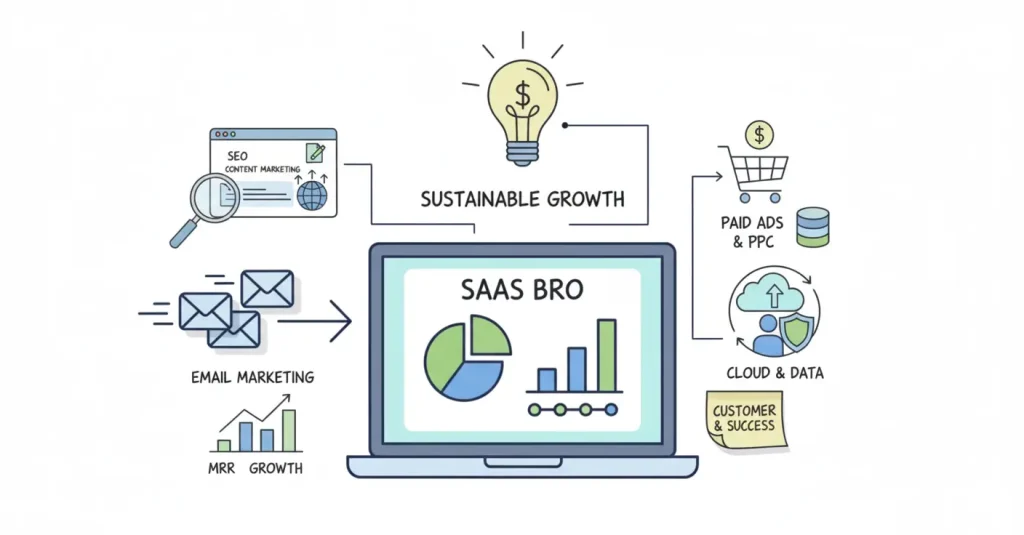
This roadmap shows how different services like SEO, content writing, link building, and even PPC can work together to drive growth. And with that, we can now see just how important SEO is for any SaaS business.
Frequently Asked Questions (FAQs)
Thinking about the next steps is exciting, and it’s smart to have questions. We’ve answered the most frequent ones below. Let’s get you the clarity you’re looking for.
How long does SEO take to show results in SaaS?
SEO is a long-term game. While you might see some small improvements in the first few months, it typically takes 6-12 months to see significant results. This is because it takes time to create high-quality content, build authority, and for search engines to recognize these changes.
Should a new SaaS startup invest in SEO early?
Yes, but with the right expectations. In the very beginning, you should focus on foundational SEO work like keyword research and technical optimization. As you get closer to product-market fit, you can start to invest more heavily in content creation and link building.
How can I track the ROI of my SaaS SEO efforts?
Track your return on investment by setting up goals in Google Analytics for demo requests or trial sign-ups. By connecting this data to your CRM, you can see how many organic visitors become actual paying customers, linking SEO directly to revenue.
What kind of content works best for SaaS SEO?
Content that helps users make a buying decision works best. This includes comparison pages, “alternative to” articles, and detailed case studies. This content attracts people who are ready to buy and helps them choose your product.
Can SEO really lower my CAC compared to PPC?
Yes, SEO can greatly lower your Customer Acquisition Cost (CAC) over time. While you always pay for PPC ads, a top-ranking page can bring in free organic traffic for years. This makes SEO a very cost-effective marketing strategy.
What makes SaaS SEO different from regular SEO?
SaaS SEO is unique because it focuses on a subscription model, not a single sale. The goal is to attract long-term customers. It uses specific content, like integration pages and tutorials, to support a much longer sales cycle.
Ready to Grow Your SaaS with SEO?
So, we’ve come back to our original question: how important is SEO in a SaaS business? As you’ve seen, it’s not just important; it’s a fundamental part of building a successful and sustainable SaaS company.
SEO provides a steady stream of high-quality leads, builds trust with your audience, and lowers your customer acquisition costs over time. It doesn’t replace the need for other marketing channels like PPC, but it complements them perfectly.
If you’re ready to build a strong foundation for your SaaS business, SaaS Bro is here to help. We offer full-stack SaaS SEO, PPC, content, design, and CRO support to help you grow.