How to Find Good Niche SaaS Ideas (Step-by-Step Service for Founders)
Ever wonder why most Software-as-a-Service (SaaS) ideas fail? It’s often because they try to be everything to everyone. The secret to survival is finding a small, specific group of people and solving a big problem for them. That’s where niche SaaS comes in.
This article will show you exactly how to find, test, and choose a great niche SaaS idea. I’ve used these simple steps to help many new businesses get started. My approach is all about being smart, starting small, and making sure people will pay for your product before you build it.
Why Finding a Good Niche SaaS Idea Matters
Before we start looking for ideas, let’s understand what a good one looks like. A niche SaaS is a software made for a very specific group of people or a particular industry. Think of a tool specific to wedding photographers or software for small, family-owned bakeries. These are different from big, general tools that anyone can use.
There are a few types of niche SaaS:
- Niche SaaS: Software for a specific audience.
- Micro-SaaS: A very small tool, often built by one or two people, that solves one tiny problem really well.
- Vertical SaaS: Software created for a whole industry, like healthcare or construction.
So, what makes an idea great? It should have these key things:
- Solves a Real Pain: It must fix a real, painful problem that people are struggling with.
- People Will Pay for It: It’s not a good business if no one is willing to pay for your solution.
- Easy to Reach Your Audience: You need to know where to find your customers online or offline.
- Can Grow Bigger: The idea should have the potential to grow and make more money over time.
- Hard to Copy: It’s great if you can do something that others can’t easily copy.
For example, an idea for a general to-do list app is bad because there are too many competitors. But a to-do list app made just for nurses to manage their patient tasks is a good niche idea. It solves a specific pain for a specific group.
If you choose the right niche, you can scale without spending a fortune on ads. It’s about focus, not size.
How to find good niche SaaS ideas: 7 Proven Methods
Now for the fun part: learning exactly how to find good niche SaaS ideas. Here are seven simple ways to discover a winning strategy.
1. Solve a Problem You Have
The best ideas often come from our own problems. Think about your job or hobbies. What tasks are annoying or take too much time?
- Why it works: If you have a problem, others like you probably do too. You are your first customer, so you understand the problem deeply.
- How to do it: Write down everything that frustrates you for a week. Also, ask your friends or coworkers about their frustrations.
- Real example: A freelance writer was tired of using five different tools to manage his clients, projects, and invoices. He built a simple tool that did it all in one place.
- Watch out for this: Make sure the problem is big enough that other people will pay to solve it, not just a personal pet peeve.
2. Listen to Complaints on Forums
People love to complain online. This is a goldmine for ideas.
- Why it works: You get to hear about real problems directly from the people experiencing them.
- How to do it: Go to websites like Reddit, Facebook groups, or product review sites. Look for phrases like “I wish there was a tool that…” or “I hate it when…”.
- Real example: Someone on a Reddit forum for dentists complained about how hard it was to manage patient appointments. A developer saw this and created a simple booking software just for dental clinics.
- Watch out for this: Don’t just take one person’s complaint as proof. Look for patterns where many people are complaining about the same thing.
3. Improve an Existing SaaS
You don’t always have to invent something new. Sometimes, you can take a popular product and make it better for a specific group.
- Why it works: The main idea is already proven to work. You just need to make it more focused.
- How to do it: Look at popular software like Trello or Slack. Think about a specific industry, like construction. How could you change that software to be perfect for construction teams?
- Real example: Trello is a general project management tool. A company created a similar tool but added features just for marketing teams, like a calendar for social media posts.
- Watch out for this: Make sure your changes are valuable enough that people will choose your tool over the big, popular one.
4. Look at Fast-Growing Niches
New trends create new problems. If you can spot a trend early, you can be one of the first to offer a solution.
- Why it works: Fast-growing areas have less competition.
- How to do it: Pay attention to new technologies like artificial intelligence (AI) or growing industries like telehealth. Think about what new problems people in these areas might have.
- Real example: With more people working from home, a company created a SaaS tool to help remote teams feel more connected.
- Watch out for this: Don’t chase trends that might disappear quickly. Make sure the niche has long-term potential.
5. Go Deeper, Not Wider
Instead of trying to serve a huge audience, focus on a very small, specific group.
- Why it works: It’s easier to become the #1 solution for a small group than for a big one.
- How to do it: Start with a broad audience, like “small businesses,” and keep narrowing it down. For example: “small businesses” -> “restaurants” -> “pizza shops” -> “pizza shops that only do delivery.”
- Real example: Instead of a general accounting software, a founder created an accounting tool just for freelance artists.
- Watch out for this: Make sure the niche isn’t so small that there aren’t enough customers to build a business.
6. Talk to People
The best way to find problems is to talk to people and listen carefully.
- Why it works: You get direct feedback on what people need and what they would pay for.
- How to do it: Find people in an industry you’re interested in and ask them about their work. Ask open-ended questions like, “What’s the most frustrating part of your day?”
- Real example: A founder interviewed 20 different yoga studio owners and learned that they all struggled with managing class schedules. She then built a SaaS tool specifically for that.
- Watch out for this: Don’t try to sell your idea in these conversations. Just listen and learn.
7. Spot Gaps Using Tools
You can use online tools to find what people are searching for but can’t find.
- Why it works: It shows you what people are actively looking for a solution to.
- How to do it: Use keyword research tools to look for searches like “software for plumbers.” You can also look at app marketplaces and read the bad reviews of existing apps to find their weaknesses.
- Real example: Someone noticed many bad reviews for a popular social media scheduling tool. The reviews all complained about the same missing feature. He built a new tool that included that feature.
- Watch out for this: Just because people are searching for something doesn’t mean they will pay for it. You still need to validate the idea.
How to Evaluate & Prioritize Ideas (Validation Stage)
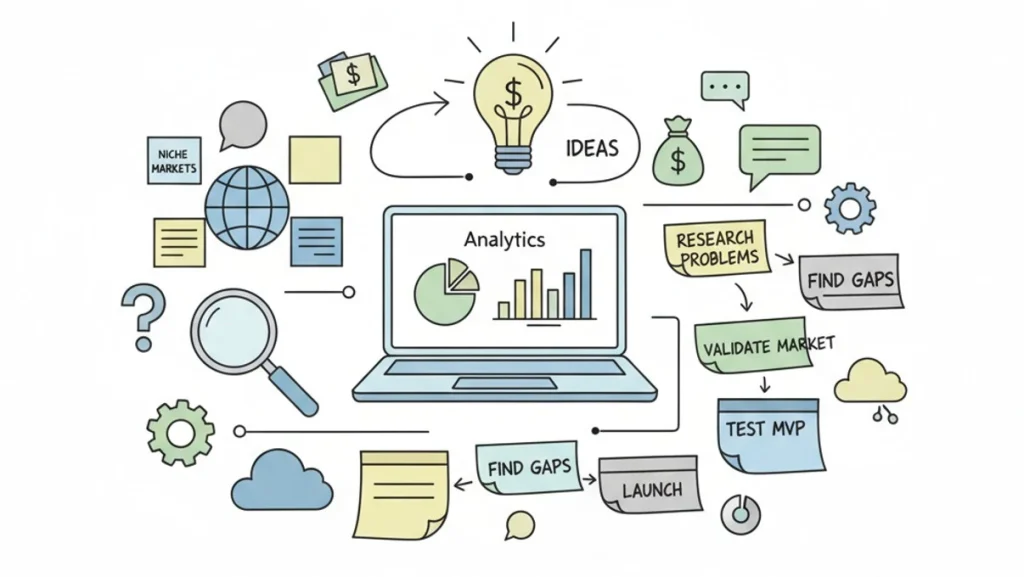
Got a few ideas? Great. Now, how do you pick the winner? The secret is validation—testing your idea in the real world before you build anything.
You don’t need to write any code for this. A powerful first step is to create a simple landing page that describes your product. If people are interested enough to leave their email, you know you’re onto something. This is how you prove people actually want what you’re offering.
Once an idea shows promise, you can build a Minimum Viable Product (MVP). This is just the simplest version of your product that solves the core problem, allowing you to get feedback from real users.
For example, a founder with an idea for dog walkers made a simple webpage and shared it on Facebook groups. He got over 100 sign-ups in a week, proving his idea was a winner before he spent a dime on development.
Market Research & Competitive Landscape
Your goal is to find other companies that are already solving the same problem. Some will be your direct competitors, doing almost the exact same thing you plan to do. Others will be indirect competitors, solving the problem in a totally different way.
Now for the fun part: finding their weaknesses. Go to software review sites like G2 or Capterra and start reading what their customers are saying. The bad reviews are pure gold! They are a roadmap showing you exactly what customers hate and what features they wish existed.
Once you know what everyone else is doing, and what they’re doing wrong, you can find your own special spot. You can win by focusing on an even smaller niche, offering amazing customer service, or just being way easier to use.
And remember, seeing other players in the game is a good thing! It proves people are already spending money to solve this problem. You just have to do it better for your specific audience.
Your Action Plan: From Idea to Reality
Feeling inspired? It’s time to turn that energy into action. Here is a simple plan to guide you from a blank page to a validated idea in just 90 days.
Your 30-60-90 Day Launchpad
Think of the next three months as a focused sprint. In the first 30 days, your mission is to become an idea machine. Pick two of the discovery methods we talked about earlier and challenge yourself to generate at least 10 solid ideas. For each one, do some quick, basic research to see what’s out there.
During the next 30 days, you’ll become a detective. Choose your top three ideas from your list and put them to the test. Create a simple landing page for each one to see if you can get people to sign up with their email. Your goal is to also talk to at least 10 potential customers to hear about their problems firsthand.
Finally, in the last 30 days, you’ll make your decision. Based on your landing page results and customer conversations, you can confidently pick the winning idea. Now you’re ready to start planning your Minimum Viable Product (MVP) and take the first real step toward building your business.
Helpful Tools and Templates
To make this process even easier, here are a few templates you can use to stay organized and effective.
First, an Idea Scorecard is a simple spreadsheet that helps you rate your ideas against important criteria. This brings clarity and helps you objectively compare your options.
Next, an Interview Script gives you a list of smart, open-ended questions to ask potential customers. This ensures you’re not just selling your idea but are truly listening and learning.
Finally, a Landing Page Checklist will make sure your validation pages have everything they need to capture interest and convince visitors to sign up.
Common Mistakes & How to Avoid Them
Now that you know how to find good niche SaaS ideas, let’s look at the common mistakes that should be avoided. Many new founders make the same mistakes. Here’s how to avoid them.
- Trying to Solve Everything: Don’t add too many features. Start with one core feature that solves the main problem.
- Picking a Niche You Can’t Reach: Make sure you have a clear way to connect with your target audience.
- Building Before Validating: This is the biggest mistake. Always test your idea first.
- Ignoring Feedback: Listen to what your potential customers are telling you, even if it’s not what you want to hear.
- Chasing Hype: Don’t build something just because it’s trendy. Focus on solving a real, painful problem.
Don’t fall into this trap: Building a product without talking to customers is like building a restaurant before checking if anyone is hungry.
Frequently Asked Questions
Here are answers to some common questions people ask when trying to find good niche SaaS ideas.
What makes a SaaS idea “niche” enough?
A niche idea focuses on a very specific group of people or a single industry. Instead of building for all businesses, you build a tool just for dentists or only for freelance writers. This focus makes it easier to succeed.
How much money do I need to start a SaaS business?
You can start with very little money. The key is to validate your idea with a simple landing page or survey first. This helps you prove people will pay for your product before you spend a lot on building it.
Do I need to be a programmer to build a SaaS?
No, you don’t. Many founders are not technical. You can partner with a technical co-founder or use no-code tools to build the first version of your product. The most important skill is understanding your customer’s problem.
What if someone steals my idea?
Ideas are easy, but building a successful business is hard. Your unique execution and deep understanding of your niche audience are what will make you successful, not just the idea itself. Focus on serving your customers better than anyone else.
How do I know if people will pay for my idea?
The best way to know is to ask them for money before you build the product. You can offer a special discount to the first group of customers who pre-order. If people are willing to pay up front, you have a winning idea.
What is the difference between niche SaaS and micro-SaaS?
Niche SaaS targets a specific industry or customer type. Micro-SaaS is even smaller, often run by one person, and solves one tiny problem extremely well. Many micro-SaaS products are also niche products.
How long should it take to validate my idea?
Validation can take anywhere from a few weeks to a couple of months. The goal is not to rush but to be confident that you are solving a real problem that people will pay to fix. Don’t start building until you’re sure.
Find Your Winning Idea
Learning how to find good niche SaaS ideas isn’t about luck. It’s about following a clear, proven path. You now have the roadmap. It all starts with understanding what makes a great idea, then using proven methods to uncover real-world problems that people are desperate to solve.
From there, you must validate your best concepts with actual customers, research the competitive landscape to find your unique angle, and learn from common mistakes to stay ahead.
So here’s your challenge: don’t just close this tab. Pick one or two of the methods we covered and find five potential ideas this week. Then, take the most exciting step of all and try to validate one of them. Your journey to building something great starts with that single action.