How to Do SaaS Content Marketing? Master the Secrets of High-Growth SaaS Brands
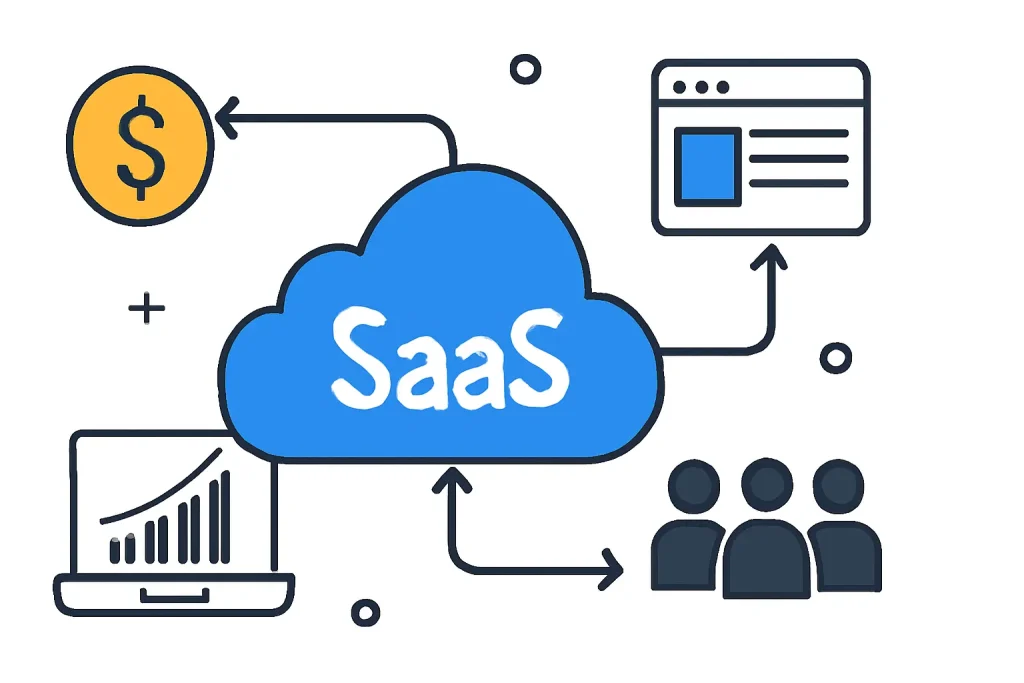
Growing your SaaS business can feel like a puzzle. You have a great product, but you need people to see it. This is where content marketing comes in. It’s a powerful way to bring customers to you.
This guide will show you how to do SaaS content marketing the right way. We will break down everything into simple steps. At SaaS Bro, we help businesses grow with services like SaaS PPC, SEO, and content writing. We use these same strategies to get real results.
Our goal is to give you a clear plan. We will follow a special framework to make your content strong and trusted. Let’s get started.
What is SaaS Content Marketing? (And Why It’s Not Just About Blogging)
SaaS content marketing is about creating helpful stuff for your audience. This could be blog posts, videos, or guides. The goal is to help people solve their problems.
This is not just about writing blog posts. It’s a full marketing strategy. It helps you build trust with your audience. When people trust you, they are more likely to buy from you. This is very important for SaaS companies because customers often stay for a long time.
Good content shows you are an expert. It helps your target audience see you as a guide. This builds a strong relationship from the start.
Now that we have a basic idea, let’s look at the best way to build your plan.
How SaaS Content Marketing Differs from Traditional B2B Content
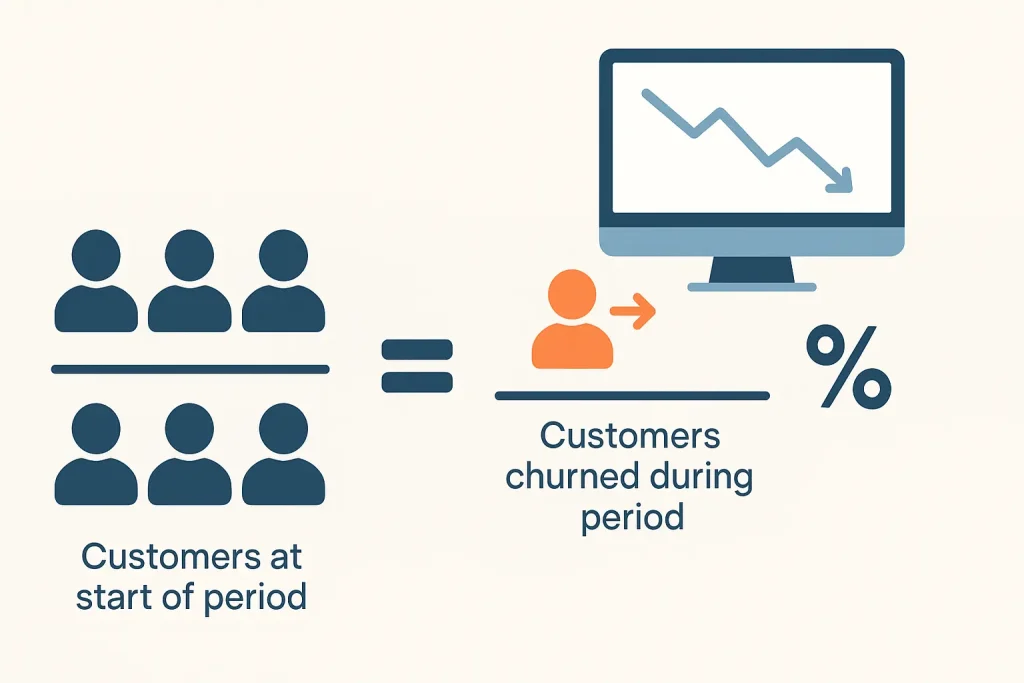
In traditional B2B, you might sell a one-time license or a big deal and then move on. In SaaS, you sell recurring subscriptions, and you care a lot about retention, activation, and churn. Because of this, your content has to do more than raise awareness: it must support the entire lifecycle.
Attributes like “retention content”, “upsell content”, and “onboarding guides” become as important as awareness articles. Also, your buyer journeys are longer, involve many decision-makers, and your metrics differ (e.g., activation rate, LTV/CAC).
This shifts how you approach keyword research, topic clusters, and content formats. Now that you know how it differs, let’s map the journey.
Mapping the SaaS Customer Journey to Content Strategy
Think of the journey in stages: Awareness → Consideration → Decision → Retention/Expansion.
- At the Awareness stage, you might publish a blog post like “Why product teams struggle with X”.
- At Consideration, you might run a guide: “How to compare tools for Y”.
- At Decision, you might offer a case study or demo: “See how Company Z reduced churn by 30%”.
- At Retention/Expansion, you’d use tutorials, onboarding content, and advanced tips for existing users.
Attributes we cover here include “customer acquisition cost (CAC)”, “lifetime value of a customer (LTV)”, “activation rate metric”, and “retention marketing tactics”.
When you map content to each stage, you build a chain that flows from first visit to loyal user.
The Foundation of Your SaaS Content Marketing Strategy: Step-by-Step Blueprint
To win at content marketing, you need a smart plan. We will use the Korey Gubur framework. This is a special way to think about content. It helps you become a true authority on your topic.
Instead of just focusing on one keyword, this framework helps you cover a whole topic. Think of it like building a big, strong web of information. This web answers every question your customer might have. This approach is perfect for building topical authority.
When you cover a topic so well, Google sees you as an expert. This helps you build E-E-A-T. That stands for Experience, Expertise, Authoritativeness, and Trustworthiness. It’s what Google looks for.
With this framework as our guide, our first step is to really know who we are talking to.
Step 1: Deeply Understand Your Audience and Their Journey
You cannot create great content if you don’t know your audience. The first step is to learn everything about your ideal customer. This is a key part of your strategy development.
Start by creating a buyer persona. This is a simple profile of your perfect customer. Think about their job, their challenges, and what they want to achieve. What are their biggest pain points?
Next, think about the buyer’s journey. This is the path people take before they buy your product. As we talked before, it has four main stages: awareness, consideration, decision, and Retention. People need different information at each stage.
When you understand the customer journey, you can create content that helps them at every step. This makes your marketing feel helpful, not pushy.
Once you know who you are talking to, it is time to set clear goals for your content.
Step 2: Setting SMART Goals for Your SaaS Content Marketing Efforts
Good content needs good goals. You need to know what you want to achieve. This is where we talk about measurement and optimization. It’s important to track your progress.
We use SMART goals to make this easy. SMART stands for Specific, Measurable, Achievable, Relevant, and Time-bound. This helps you set clear targets.
For example, a SMART goal could be: “Increase website traffic from our blog by 20% in the next three months.” This is much better than just saying “get more traffic.” You can measure it.
Other important numbers to track are conversion rates and customer acquisition cost (CAC). These show you if your content marketing efforts are making money for your SaaS business. Clear goals keep your team focused.
With your goals in place, the next step is to plan what kind of content you will create.
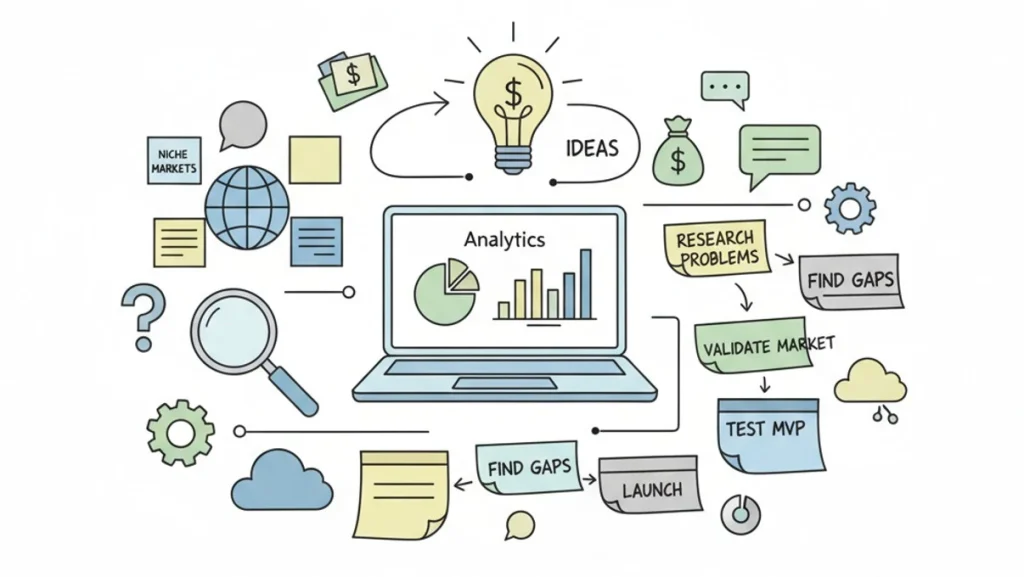
Step 3: Building Your Content Lifecycle and Topical Map
Now we plan your content for every stage of the buyer’s journey. This is called a content lifecycle. It helps you have the right content for the right person at the right time.
This plan is your content strategy. It’s like a map for your visitors. Let’s break it down into three parts.
Top of Funnel (ToFu): Awareness Stage
At this stage, people have a problem but don’t know the solution yet. Your job is to educate them. Create blog posts, infographics, and social media updates that help them understand their problem. The goal here is to attract a lot of people.
Middle of Funnel (MoFu): Consideration Stage
Now, people know about solutions and are looking at their options. Your content should show why you are a great choice. You can create detailed whitepapers, case studies, and webinars. This content helps generate leads.
Bottom of Funnel (BoFu): Decision Stage
At the bottom of the funnel, people are ready to buy. They need that final push. Offer free trials, live demos, and detailed comparison guides. This content helps turn a potential customer into a paying one.
Now that you have a strategic map, let’s talk about creating the content itself.
Step 4: Creating High-Value Content That Converts
This is where your content creation happens. You need to make things that are truly helpful and interesting. Quality is more important than quantity. Each piece of content should have a clear purpose.
Here are some popular types of content for B2B SaaS companies:
Blog Posts and Articles
These are great for search engine optimization (SEO). They help you rank on Google and attract new visitors. Write about topics your target audience cares about. This builds thought leadership.
Whitepapers and Ebooks
These are longer, more detailed guides. They are perfect for capturing email addresses and leads. You give away valuable information in exchange for contact details.
Case Studies
Case studies are success stories from your real customers. They build a lot of trust. They show potential buyers that your product can solve their problems. This is powerful social proof.
Webinars and Videos
Videos are very engaging. You can use them for tutorials, product demos, or expert interviews. Webinars are great for teaching your audience something new and answering their questions live.
Creating great content is a big step. The next step is making sure people see it.
Step 5: A Multi-Channel Approach to Content Distribution and Promotion
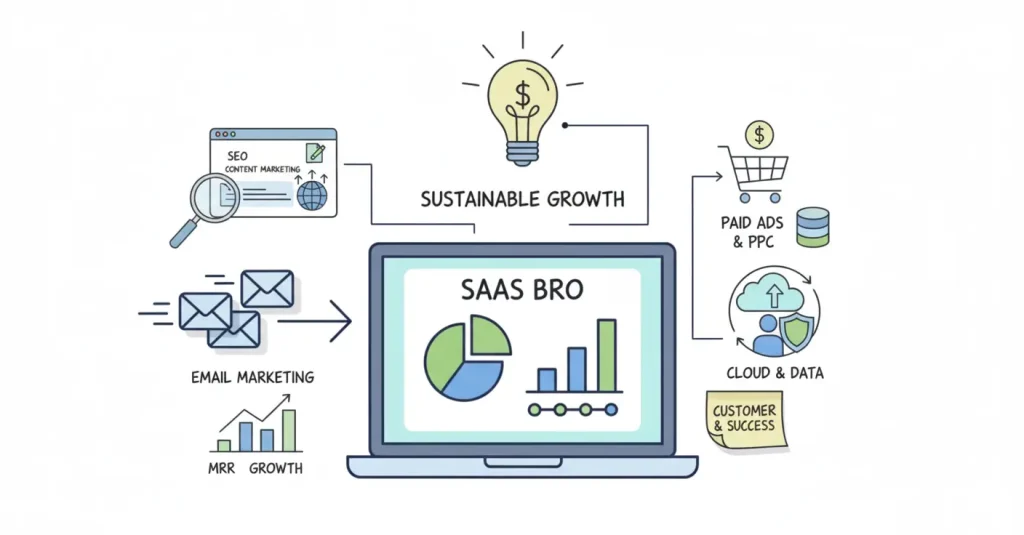
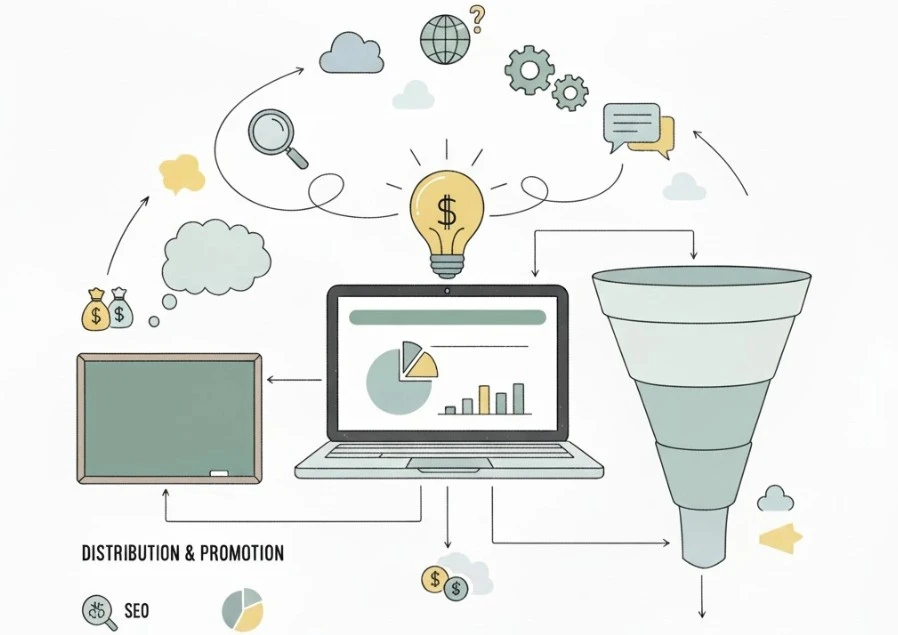
Your amazing content won’t help anyone if they can’t find it. Content distribution is just as important as content creation. You need a plan to share your work with the world. A good plan uses many channels. This helps you reach more people. Here are the most important ones for SaaS companies.
SaaS SEO
Search engine optimization helps your content show up on Google. This means working on your keywords, getting backlinks, and making sure your site is fast. Good SEO brings you organic traffic for a long time.
SaaS PPC and Google Ads
Sometimes you need a quick boost. Paid ads, or PPC, can get your content in front of many people fast. You can use SaaS Google Ads to target specific people who are looking for your solution.
SaaS Email Marketing
Email is a great way to talk to your audience directly. You can send your new blog posts or whitepapers to your email list. This is called lead nurturing. Our SaaS email marketing services can help you set this up.
Social Media
Share your content on platforms like LinkedIn and Twitter. This helps you join conversations and build a community around your brand. It is a great way to drive traffic and engage with your followers. As your content starts getting views, you must track what’s working. This lets you make things even better.
How to Do SaaS Content Marketing That Drives Results
So, let’s put it all together. The best way to learn how to do SaaS content marketing is to follow a clear process. It all starts with the Korey Gubur framework, which helps you build trust and authority.
First, you deeply understand your customer and their journey. Then, you set smart goals to guide you. After that, you build a content map for every stage, from awareness to decision.
Next, you create amazing content that solves real problems. Finally, you share that content everywhere your audience hangs out, using SEO, PPC, and email. This is how you build a powerful content machine. This integrated approach, which combines everything from SaaS website design to digital marketing, is what drives tangible results.
This process builds a strong foundation. It brings in steady leads and helps your SaaS business grow for years to come.
Frequently Asked Questions
You now have the complete blueprint to build a high-growth SaaS content engine. But before you start laying the foundation, let’s clear up those final, nagging questions. Think of this section as your quick-reference guide for instant clarity, so you can move forward with total confidence.
What is the main goal of SaaS content marketing?
The main goal is to attract, engage, and convert customers for your software. It focuses on creating valuable content, like blog posts and videos, to build trust and guide users to purchase your subscription-based product.
How is SaaS content marketing different?
It focuses more on retention and the entire customer lifecycle, not just awareness. Since SaaS is a subscription model, content must support users through onboarding, problem-solving, and upgrading to reduce churn and increase lifetime value.
What content works best for SaaS?
Blog posts and tutorials are great for attracting new users. Case studies, whitepapers, and webinars work well for converting leads. For existing customers, onboarding guides and advanced tip articles are essential for retention.
How do you measure the success of SaaS content marketing?
Success is measured by tracking metrics like organic traffic, lead generation, conversion rates, and customer acquisition cost (CAC). For SaaS, it’s also vital to monitor user activation rates and customer lifetime value (LTV).
Why is E-E-A-T important for SaaS content?
E-E-A-T (Experience, Expertise, Authoritativeness, Trustworthiness) is crucial because SaaS products can be complex and expensive. High-quality, expert-driven content builds the trust needed for a customer to commit to a recurring subscription.
What is a SaaS content strategy?
It is a detailed plan for creating and distributing content to achieve business goals. This involves understanding your audience, mapping content to the customer journey, setting goals, and promoting your content through channels like SEO and email.
Ready to Build Your SaaS Content Engine?
Content marketing for a SaaS business is a marathon, not a sprint. It takes time and effort, but the rewards are huge. By creating helpful, valuable content, you build lasting relationships with your customers.
We have covered a lot today. We talked about understanding your audience, setting goals, creating content, and promoting it. Remember to always focus on helping your reader. Be the expert they can trust.
By following these steps, you will have a clear roadmap for how to do SaaS content marketing successfully. This will help you attract the right customers and grow your business.